Defensibility-Grade Integrated Controls: The Operating Model Beyond Integrated Surveillance
Executive Summary
Most financial institutions have invested heavily in surveillance technology, yet many still cannot answer a fundamental question when examined: Can you trace a regulatory obligation through your control design, monitoring, case outcomes, and remediation, with reproducible evidence at every step?
The inability to answer that question is not a technology problem. It is an operating-model problem rooted in fragmentation: of taxonomies, data, workflows, governance, and accountability. Disconnected controls produce inconsistent outcomes, weak evidence chains, and slow remediation cycles that erode defensibility precisely when it matters most.
This paper defines defensibility-grade integrated controls as a control-system capability: the ability to maintain end-to-end, auditable lineage from obligation to outcome, supported by a closed improvement loop that converts observed conduct into durable risk reduction. Integration is not systems stitched together. It is a control-system property that produces reproducible, examinable evidence at scale.
The paper provides eight falsifiable tests, a five-level maturity model with observable artifacts, a taxonomy of common failure modes, and a phased adoption path – concrete tools for compliance operations leaders to assess their programmes and sequence improvement for maximum defensibility gain.
1. The Problem: Fragmentation Breaks Defensibility
1.1 Disconnected Controls, Disconnected Evidence
In a typical financial institution, directive controls (policies, obligations, procedures) live in document repositories or GRC platforms. Preventive controls (information barriers, conflicts management, pre-clearance, personal account dealing approvals) operate in separate systems. Detective controls (communications surveillance, trade surveillance, transaction monitoring) run on dedicated platforms with independent alert pipelines. Investigations, case management, and remediation tracking each occupy their own systems and workflows.
Each function may individually perform well. But when they operate in isolation, the institution cannot produce what examiners increasingly demand: a coherent, end-to-end evidence trail that demonstrates how an obligation became a control, how that control detected or prevented relevant conduct, what investigation followed, what corrective action was taken, and how the programme improved as a result.
1.2 The Consequences of Fragmentation
Fragmentation produces three compounding problems:
1. Inconsistent outcomes. Without a unified taxonomy linking obligations to controls, different teams interpret the same obligation differently, design controls with different coverage assumptions, and produce non-comparable results.
2. Weak evidence chains. When a regulator asks a firm to reconstruct the control story for a specific individual over a defined period, fragmented programmes require weeks of manual assembly across multiple teams. The resulting evidence package is neither reproducible nor independently verifiable.
3. Slow remediation. Without a closed loop connecting detection outcomes back to control design, the same categories of conduct recur. Supervisory findings accumulate rather than resolve.
These are the operational patterns that examination teams consistently identify as the basis for governance-related findings that persist across supervisory cycles.
2. Definition: Defensibility-Grade Integrated Controls
2.1 Integration as a Control-System Property
Defensibility-grade integrated controls is a control-system property, not a technology property. A programme possesses this property when it can demonstrate four characteristics within a defined perimeter:
1. Traceability. Every regulatory obligation and internal policy is mapped to specific preventive and detective controls in a unified, version-controlled taxonomy.
2. Reproducibility. Any case can be reconstructed end-to-end – from triggering signal through investigation to disposition and corrective action – without manual assembly across disconnected systems.
3. Governance. Control design changes, model updates, rule tuning decisions, and threshold modifications are documented with rationale, approval, and impact assessment.
4. Scale. The above properties hold consistently across channels, populations, languages, and business lines within the defined perimeter, not just for flagship scenarios, primary-language content, or pilot populations.
2.2 The Defensibility Loop
The core operating model is a closed loop with six stages (obligation and policy are consolidated into a single stage because policy is the firm's direct translation of its obligations), each producing specific evidence artifacts:
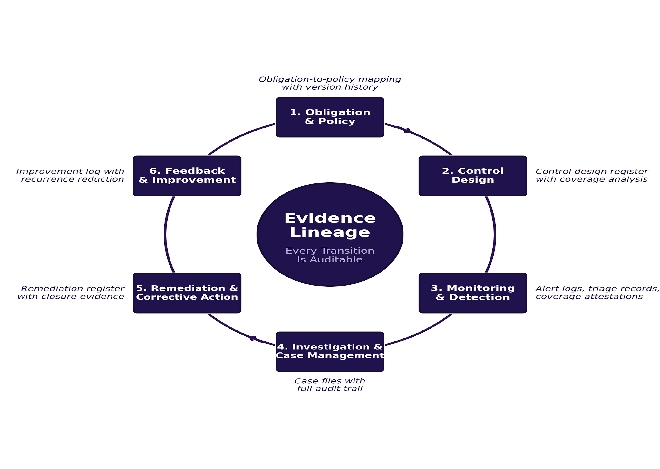
Stage 1 – Obligation & Policy: Regulatory obligations are identified, mapped to internal policies, and linked to specific control requirements. Artifact: obligation-to-policy mapping with version history.
Stage 2 – Control Design: Preventive controls (barriers, approvals, restrictions) and detective controls (surveillance scenarios, monitoring rules, models) are designed and documented for each obligation. Artifact: control design register with coverage analysis.
Stage 3 – Monitoring & Detection: Controls operate across defined channels, populations, and languages. Alerts are generated, triaged, and routed. Artifact: alert generation logs, triage records, coverage attestations.
Stage 4 – Investigation & Case Management: Escalated alerts are investigated with access to cross-domain context. Dispositions are recorded with rationale. Artifact: case files with full audit trail.
Stage 5 – Remediation & Corrective Action: Confirmed findings trigger documented corrective actions: disciplinary measures, process changes, control adjustments, or targeted training. Artifact: remediation register with closure evidence.
Stage 6 – Feedback & Improvement: Case outcomes are classified and analysed. Conduct arising from unawareness or process failure feeds back into preventive controls; detection models are retuned based on observed patterns. The classification of conduct into intentional misconduct versus unawareness is an operational triage device, not a legal determination; its value lies in routing remediation systematically. Artifact: improvement log with measured recurrence reduction.
If any transition between stages requires manual reconstruction or produces no retained evidence, the loop is broken at that point, and so is defensibility.
3. Preventive vs. Detective Controls: and Why They Must Be Unified
Preventive controls act before conduct occurs: information barriers, personal account dealing (or personal trading) restrictions, pre-clearance requirements, conflicts-of-interest determinations, and automated policy enforcement. Detective controls act after conduct occurs: communications surveillance, trade surveillance, transaction monitoring, and behavioural analytics.
Most compliance programmes manage these categories in separate organisational silos. This separation creates three defensibility gaps:
1. Context loss. When a surveillance alert fires, the investigator may lack visibility into relevant preventive-control decisions (barrier crossings, pre-clearance approvals, restriction list status) that would materially change the investigation's direction.
2. Overlapping coverage with unmanaged residual risk. Preventive and detective controls may overlap on well-understood risk scenarios while leaving gaps in emerging or cross-domain scenarios that neither team owns.
3. Broken improvement loop. If detective controls identify recurring conduct that could be addressed through preventive measures, but no systematic mechanism exists to feed findings into preventive control design, the programme remains permanently reactive.
Unification does not require a single platform. It requires shared taxonomy, automated data linkage, defined handoff protocols, and a governance structure that owns the seams between preventive and detective functions. At minimum, this requires shared entity identifiers (person, account, instrument, channel), API-level data access across systems, and documented escalation triggers at each handoff point.
4. The Defensibility Loop: Operating Model Detail
The six-stage loop operates as a continuous cycle. Its effectiveness depends on three operating principles:
Principle 1 – Evidence at every transition. Each handoff must produce a retained, queryable record. The obligation-to-control mapping must be version-controlled. Alert triage decisions must be documented. Investigation dispositions must include rationale. Remediation actions must be tracked to closure. Improvement actions must be measured for effect.
Principle 2 – Classification drives improvement. Every confirmed finding should be operationally classified: intentional misconduct requires full investigative rigour; unawareness or process failure should feed directly into targeted preventive controls with measured recurrence reduction.
Principle 3 – Perimeter-based implementation. Examiners assess control effectiveness within defined perimeters. A programme demonstrating the complete loop within a documented perimeter, with a credible expansion roadmap, presents stronger evidence than shallow integration across a broader but less-assured scope.
4.1 Governance and Accountability
The loop requires explicit ownership across the three lines: first line owns control execution and day-to-day operation; second line owns design standards, oversight, and challenge; third line provides independent assurance of both design and operating effectiveness.
Reporting cadence: monthly operational MI (alert volumes, triage quality, coverage metrics) to the programme owner; quarterly effectiveness report (test results, recurrence trends, remediation status) to senior management or board risk committee (or equivalent senior governance body); annual independent assurance cycle. Material control failures or perimeter gaps trigger immediate escalation to the programme owner and relevant senior management outside the regular cadence. A dedicated surveillance governance forum, or a standing agenda item within an existing risk and control committee – should own cross-function coordination, approve perimeter changes, and review the quarterly effectiveness report.
5. Falsifiable Tests: Does Your Programme Have Integrated Controls?
The following eight tests distinguish genuine integration from surface-level consolidation. Each is binary: the programme can demonstrate the capability, or it cannot.
Test 1 – Obligation Traceability. Select any regulatory obligation within the defined perimeter. Can the firm produce, on demand, the specific preventive and detective controls that implement it, with version history showing when the mapping was last reviewed?
Test 2 – Case Reproducibility. Select any closed case from a defined review period. Can an independent reviewer – someone who did not work the original case – reconstruct the full evidence chain from system records alone, without relying on the original analyst's notes or memory, and arrive at the same conclusion?
Test 3 – Cross-Domain Context. When a surveillance alert fires, does the investigator have automatic access to relevant communications, trade data, conflicts/barrier decisions, and archived records in a single workflow, without manual retrieval from separate systems?
Test 4 – Coverage Consistency. Can the firm demonstrate consistent monitoring coverage across all channels, populations, and languages within the defined perimeter, with documented rationale for any exclusions? Coverage means active detection and review, not merely ingestion or archiving.
Test 5 – Change Control. For any surveillance model, rule, or threshold change within a defined review period, can the firm produce the documented rationale, approval, impact assessment, and post-implementation performance comparison?
Test 6 – Remediation Closure. For confirmed findings, can the firm demonstrate that corrective actions were defined, assigned, tracked to completion, and verified for effectiveness – with evidence that the same conduct category did not recur at the same rate?
Test 7 – Preventive-Detective Linkage. Can the firm show specific instances where detective control findings led to documented changes in preventive controls (policy updates, barrier modifications, training programmes, system restrictions) – with measured impact on recurrence?
Test 8 – Evidence Production Speed. If asked to produce the complete control story for a specific individual over a defined period – applicable policies, preventive actions, surveillance alerts, investigation outcomes, and archived records – can the firm do so in hours rather than weeks, using system-generated outputs rather than manually assembled spreadsheets?
A programme that passes all eight tests within a defined perimeter has defensibility-grade integrated controls for that perimeter. A programme that fails three or more has material integration gaps that impair defensibility.
6. Maturity Model: Five Levels of Control Integration
Level 1 – Siloed
Characteristics: Directive, preventive, and detective controls operate in separate systems with no systematic linkage. Investigations require manual assembly of evidence from multiple systems. Observable Artifacts: Separate, unlinked policy registers and control inventories. No cross-domain case workflow. Evidence production requires weeks of effort. Common Pitfall: Teams may individually perform well, masking the absence of end-to-end defensibility.
Level 2 – Partially Connected
Characteristics: Some linkage exists between layers; policies may reference surveillance scenarios, some data flows between systems. But integration is manual, inconsistent, and not maintained through change cycles. Observable Artifacts: Spreadsheet-based obligation mappings (incomplete, not version-controlled). Manual evidence assembly possible in days but not hours. Ad hoc improvement actions following major incidents. Common Pitfall: Partial connections create a false sense of integration that does not hold under examination pressure.
Level 3 – Integrated
Characteristics: Controls are linked across directive, preventive, and detective layers with defined handoffs, shared data, and regular governance. A unified taxonomy exists and is maintained. Observable Artifacts: Maintained control library linking obligations to controls. Cross-domain investigation workflow with automated context enrichment. Coverage attestations with documented exclusion rationale. Quarterly improvement reviews with documented actions. Common Pitfall: Governance concentrated in a single function rather than distributed across the three lines, creating key-person risk.
Level 3 represents the minimum threshold at which a programme can credibly claim defensibility-grade integration within a defined perimeter.
Level 4 – Unified
Characteristics: Controls operate as a single system. Policy changes propagate automatically to preventive workflows, surveillance scenarios, and investigation playbooks. Evidence is continuous, auditable, and regulator-ready. Observable Artifacts: Automated obligation-to-control propagation with audit trail. Evidence production on demand in hours. Documented recurrence reduction metrics. Independent assurance of both design and operating effectiveness. Common Pitfall: Over-engineering the automation without maintaining human judgement and accountability at critical decision points.
Level 5 – Adaptive
Characteristics: All Level 4 properties, plus the programme proactively extends its perimeter to emerging risks: new communication channels, new languages, new conduct typologies, and automated or machine-generated communications. Observable Artifacts: Documented perimeter expansion roadmap with execution evidence. Emerging-risk detection capabilities for automated communications governance. Cross-jurisdictional evidence replication capability. Common Pitfall: Adaptive ambition outpacing operational capacity, leading to breadth without depth.
7. Common Failure Modes
Integration efforts fail for predictable reasons. Recognising these failure modes early allows programmes to address root causes rather than symptoms.
7.1 Taxonomy Fragmentation
Different functions use different classification schemes for the same underlying risks. Without a unified taxonomy, cross-function reporting is unreliable and the improvement loop cannot close.
7.2 Data Lineage Gaps
Data flows between systems without documented lineage or reconciliation controls; transformations, enrichment steps, and reconciliation points are opaque. When an examiner asks how a specific communication became (or did not become) an alert, the firm cannot reconstruct the path.
7.3 Workflow Fragmentation
Surveillance, investigations, and remediation operate as separate workflow streams with manual handoffs. Context is lost at each transition. Remediation actions are tracked separately from the cases that triggered them, breaking the evidence chain.
7.4 Governance Gaps
No single function or governance body owns the end-to-end control system. Model validation, rule tuning, threshold changes, and coverage decisions lack consistent change-control discipline. Integration claims go untested by independent assurance.
7.5 Capability and Talent Gaps
Integration is a cross-functional discipline requiring skills that span compliance, technology, and operations. Programmes that depend on a small number of cross-domain individuals face key-person risk and cannot scale the operating model. Programmes that cannot develop or acquire this capability stall at Level 2 regardless of investment in systems.
8. Phased Adoption Path: A Pragmatic Roadmap
Wholesale transformation is neither realistic nor necessary. The following phased approach sequences investment for maximum defensibility gain at each stage.
Phase 1 – Foundation: Taxonomy, Inventory, and Baseline Evidence
- Establish a unified taxonomy linking obligation categories, control types, risk scenarios, and finding classifications across all functions.
- Build a comprehensive control inventory: map every in-scope obligation to its implementing controls within a defined perimeter.
- Baseline current evidence production capability: measure how long it takes to reconstruct a case end-to-end and produce a control story for an individual.
- Document coverage: channels, populations, languages, with explicit gap documentation and risk acceptance rationale.
START SMALL. Select one high-risk perimeter, for example, market abuse surveillance for a specific trading population across primary channels, or suitability monitoring for a specific advisory population. Demonstrate the full taxonomy and inventory for that perimeter before expanding.
Phase 2 – Connect: Unify Workflow and Evidence Packaging
- Link preventive-control decisions to detective-control workflows so investigators have automatic access to cross-domain context.
- Implement cross-domain case management: communications alerts, trade alerts, and conflicts decisions flow into a single investigation workflow.
- Automate evidence packaging: the control story for an individual or a case should be producible on demand.
- Establish change-control discipline for surveillance models, rules, and thresholds.
Phase 3 – Close the Loop: Continuous Improvement
- Implement systematic breach classification: distinguish intentional misconduct from unawareness/process failure.
- Build the improvement feedback path: unawareness findings systematically trigger targeted preventive controls with measured recurrence reduction.
- Extend coverage to additional languages, channels, and populations with documented effectiveness validation.
- Commission independent assurance of the full loop, covering both design and operating effectiveness.
Conclusion
Integration is not a technology project. It is a defensibility capability – the ability to produce reproducible, auditable evidence that a firm's control system operates as designed, detects what it should detect, acts on what it finds, and improves based on what it learns.
Apply the eight tests against your programme within a defined perimeter. Identify the gaps. Prioritise those that most directly impair your ability to produce coherent evidence under examination. Sequence remediation using the phased approach. Measure progress against the maturity model.
Defensibility is not achieved by adding more technology. It is achieved by closing the loop.
Appendix: Practitioner Checklist
Falsifiable Tests Checklist
☐ Test 1 – Obligation Traceability: Can you map any obligation to its implementing controls with version history? ☐ Test 2 – Case Reproducibility: Can an independent reviewer reconstruct any case from system records alone? ☐ Test 3 – Cross-Domain Context: Do investigators get automatic access to communications, trades, conflicts, and archive data? ☐ Test 4 – Coverage Consistency: Can you demonstrate consistent coverage across channels, populations, and languages? ☐ Test 5 – Change Control: Can you produce rationale, approval, and impact assessment for any model/rule change? ☐ Test 6 – Remediation Closure: Are corrective actions tracked to completion with verified effectiveness? ☐ Test 7 – Preventive-Detective Linkage: Do detective findings systematically drive preventive control changes? ☐ Test 8 – Evidence Production Speed: Can you produce a complete control story for an individual in hours, not weeks?
Maturity Level Quick Reference
☐ Level 1 – Siloed: Controls operate independently; no cross-function linkage; evidence assembly takes weeks. ☐ Level 2 – Partially Connected: Some linkage exists; integration is manual and inconsistent; evidence in days. ☐ Level 3 – Integrated (minimum defensibility threshold): Defined handoffs, shared data, maintained taxonomy; most evidence without major reconstruction. ☐ Level 4 – Unified: Single system operation; automated propagation; evidence on demand in hours; measured improvement. ☐ Level 5 – Adaptive: Level 4 plus proactive perimeter extension; emerging-risk coverage; cross-jurisdictional evidence replication.
Phase Readiness Indicators
☐ Phase 1 Complete: Unified taxonomy exists; control inventory covers defined perimeter; baseline evidence metrics established; coverage documented with gaps acknowledged. ☐ Phase 2 Complete: Cross-domain investigation workflow operational; evidence packaging automated; change control in place for models and rules. ☐ Phase 3 Complete: Breach classification operational; improvement loop closing with measured recurrence reduction; independent assurance of full loop; perimeter expansion underway.